
The submitted SAIF poster
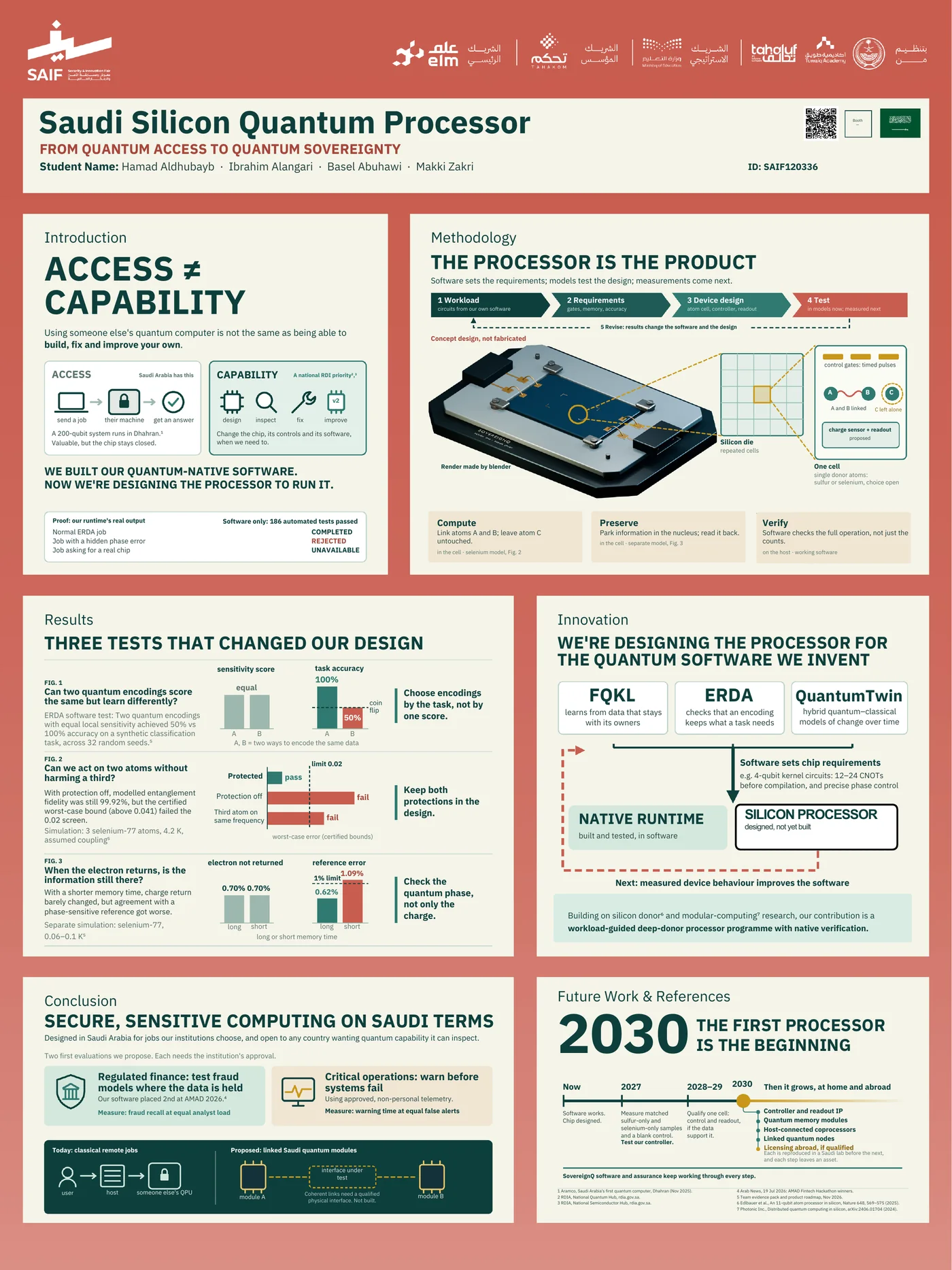
SAIF is the Security and Innovation Fair, an international exhibition and competition held in Riyadh from 24 to 26 November 2026. Our poster was submitted on 19 November 2026 and is shown here unchanged. Each step below matches a panel, with where to see it on this site and what we have learned since.
-
Introduction
Access is not capability
Renting time on someone else's quantum computer is not the same as being able to build, fix and improve your own. We built the software first. Now we are designing the processor to run it.
On this site Why access is not capability
Show this panel
-
Methodology
The processor is the product
Software sets the requirements, models test the design, and measurements come next. The poster splits the processor's work into compute, preserve and verify.
On this site Explore the processor, layer by layer
Show this panel
-
Results · Fig. 1
Equal scores, different learning
Two encodings with the same sensitivity score reached 100% and 50% accuracy across 32 random seeds. Choose encodings by the task, not one score.
Since the poster A software result. It stands as submitted.
Show this panel
-
Results · Fig. 2
Act on two atoms without harming a third
In a three-atom selenium-77 model, switching protection off still scored 99.92%, but the certified worst-case bound failed the screen. Keep both protections.
Since the poster A later model tested protection against a nearby disturbance. It held for short sequences and failed at the next length tested.
Show this panel
-
Results · Fig. 3
Is the information still there?
With a shorter memory time the electron came back just as often, but agreement with a phase-sensitive reference got worse. Check the phase, not only the charge.
Since the poster The same lesson, sharper: a near-perfect reset score can hide a missing gate.
Show this panel
-
Innovation
We design the processor for the quantum software we invent
FQKL, ERDA and QuantumTwin set the chip's requirements, and measured device behaviour will improve the software. Our contribution: a workload-guided deep-donor processor programme with native verification.
On this site See the co-design
Show this panel
-
Conclusion
Secure, sensitive computing on Saudi terms
Designed in Saudi Arabia for jobs our institutions choose, and open to any country that wants quantum capability it can inspect. The first two proposed evaluations: fraud models tested where the data is held, and early warning for critical operations, each with the institution's approval.
On this site Where it could apply
Show this panel
-
Future work
2030: the first processor is the beginning
Software works and the chip is designed. Next, measure matched samples and test our controller, then qualify one cell if the data support it. Then it grows, at home and abroad: controller and readout IP, quantum memory modules, host-connected coprocessors, linked quantum nodes, and licensing abroad, if qualified.
Since the poster Three follow-up studies and the next measurement gate
Show this panel