Change the field.
Rebuild the response.
Introduce a synthetic delivery error. Estimate a correction. Recompute the donor-pair response—and see whether the update earns acceptance.
The response decides.
An improvement alone is insufficient. The proposed command must satisfy the declared evaluation rule.
Make the connection executable.
This experiment connects a delivery parameter, a numerical plant, calibration logic and an evaluated control update. Physical interfaces and the full framework adapters remain separate development work.
Inspect what the result means.
New experiment, distinct from accepted checkpoints
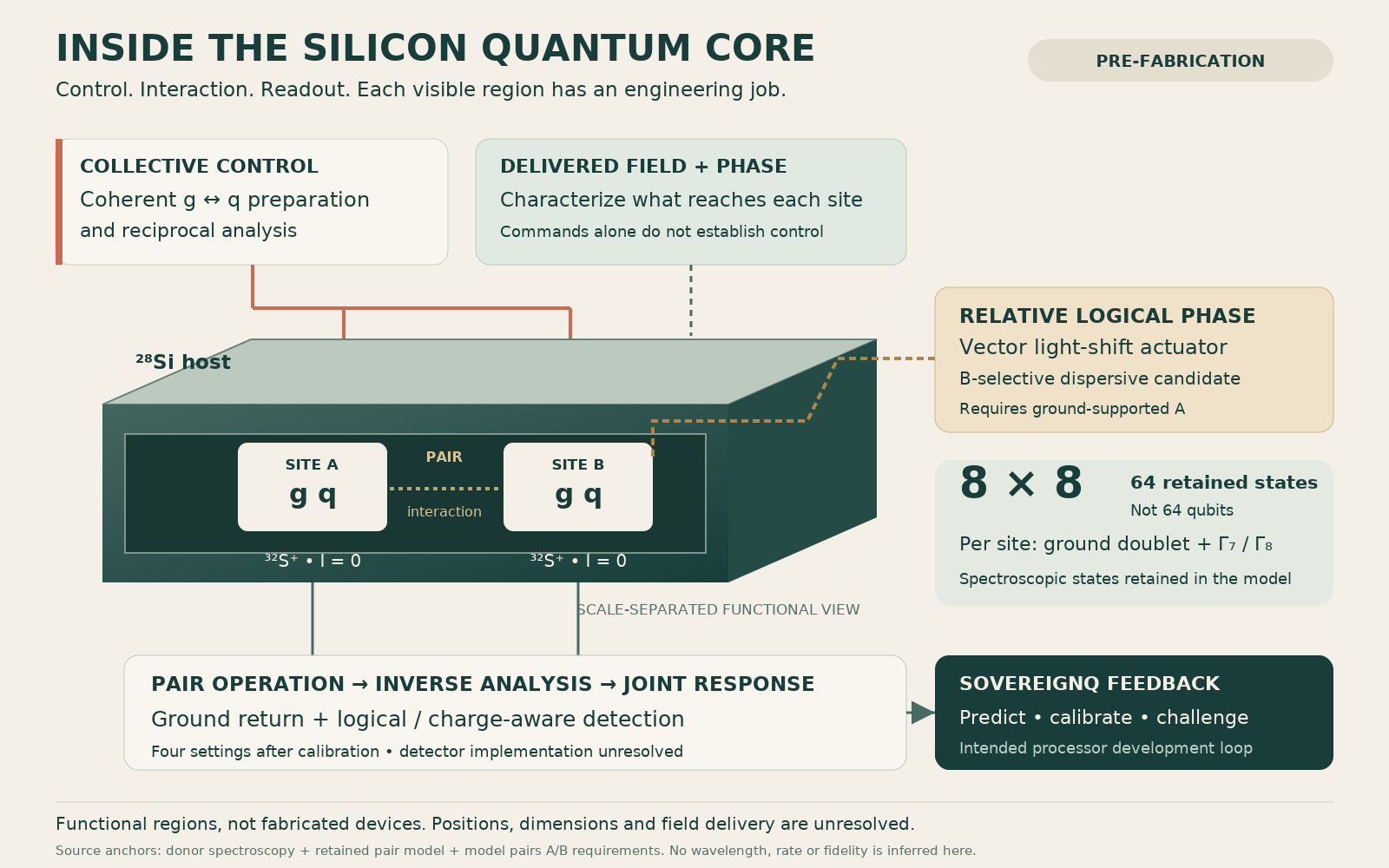
The model structure is taken from the retained donor operator sources. This calibration experiment uses explicitly declared dimensionless inputs. Its declared interaction U = 0.5 is a standalone reference choice, not the current retained same-pair evolution. This is not a replay of the earlier branch-control checkpoints or a calibrated current processor twin. It does not replace or requalify current research checkpoints. See the current research distinction.
What the algorithm knows
The estimator receives synthetic response probes. The fixed nominal target is declared independently of the perturbed trial. Recovering its response does not establish an ideal gate; the target itself has population outside the logical subspace. The physical gain slider is not supplied as the estimate. The proposed control is recomputed and separately evaluated.
What has not been demonstrated
No material characterization, delivered optical field, measured detector response, loss model, temperature performance or quantum advantage. Ideal preparation and readout remain explicit model assumptions. Passing this software exercise does not establish a hardware-ready gate. The exactly invertible one-parameter gain family is deliberately limited; it is not general calibration intelligence.
Source, equations and numerical checks
The score is the Frobenius distance, divided by two, between four propagated logical input columns across all 64 amplitudes, aligned by one common global phase. It is not a gate fidelity. JavaScript RK4 propagation was cross-checked against adaptive SciPy DOP853 and a timestep-convergence test.
Executable engine